

1. Executive summary
Private credit grew up in calm water. The asset class expanded from roughly $1T at the start of the decade to about $2T today, and Moody's projects roughly $4T by 2030. That capital was raised, deployed, and marked almost entirely in a benign-default environment. It has never been tested at scale through a sustained downturn. In 2026 the test began in earnest: the Financial Stability Board published its first dedicated report on private credit vulnerabilities, the IMF titled its Global Financial Stability Report chapter Private Credit Is Under Pressure amid Converging Headwinds, Moody's cut its outlook on the entire $400B business development company sector to negative, and Fitch's private credit default rate reached a record.1
Higher-for-longer is no longer a forecast. The Federal Reserve cut 25 basis points at three consecutive meetings in September, October and December 2025, reaching a 3.50 to 3.75% target range, and has held there through five consecutive meetings since. At the July 2026 meeting three members dissented in favor of a hike, and the June 2026 median projection puts the policy rate at 3.8% for 2026, 3.6% for 2027 and 3.4% for 2028. Floating-rate borrowers underwritten in 2021 are not being rescued by the rate path; they are living in it.2
The thesis of this paper is unchanged, and the evidence for it has strengthened. Higher-for-longer rates plus AI disruption broke the four pillars that made SaaS the ideal private credit borrower. Recovery, not origination spread, is what now separates a top-quartile vintage from a bottom-quartile one, and in an asset-light credit recovery is decided long before a process starts. Three capabilities are decisive: a standing watch that flags stress 12 to 18 months before payment default; an underwriting of the recovery itself, calibrated to asset-light businesses; and the operating capability to act on what it says.
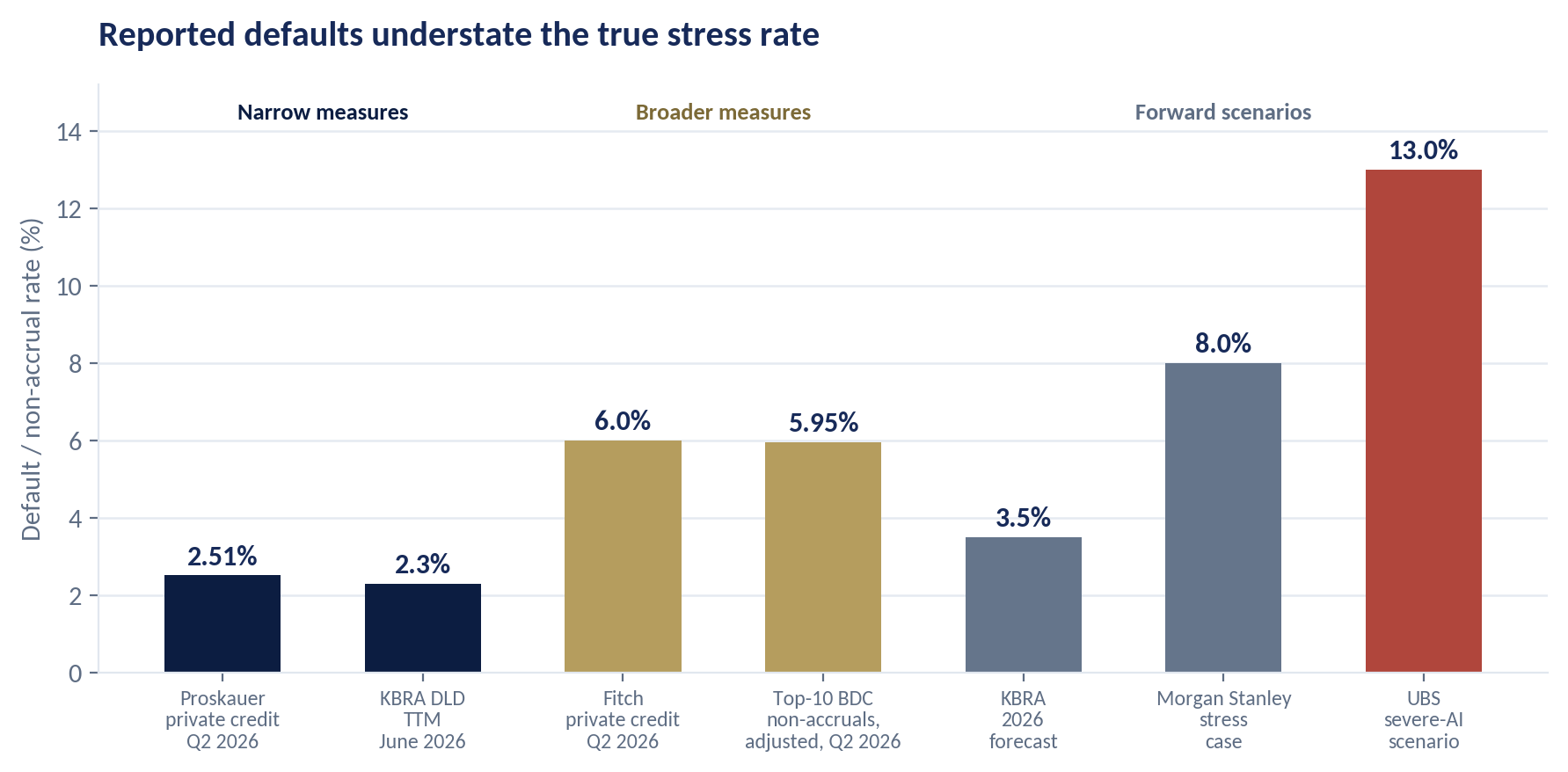
The numbers understate the stress by roughly two and a half times. Narrow indices put private credit defaults at 2.51% in Q2 2026, and KBRA's direct-lending measure at 2.3%. Fitch's broader measure, which captures the distressed exchanges and liability management exercises that narrower measures exclude, hit a record 6.0% in the same quarter. Across the ten largest public BDCs, non-accruals reached 3.95% of cost on a reported basis and 5.95% on an adjusted basis, and non-accrual debt was carried at 55.8% of cost.3
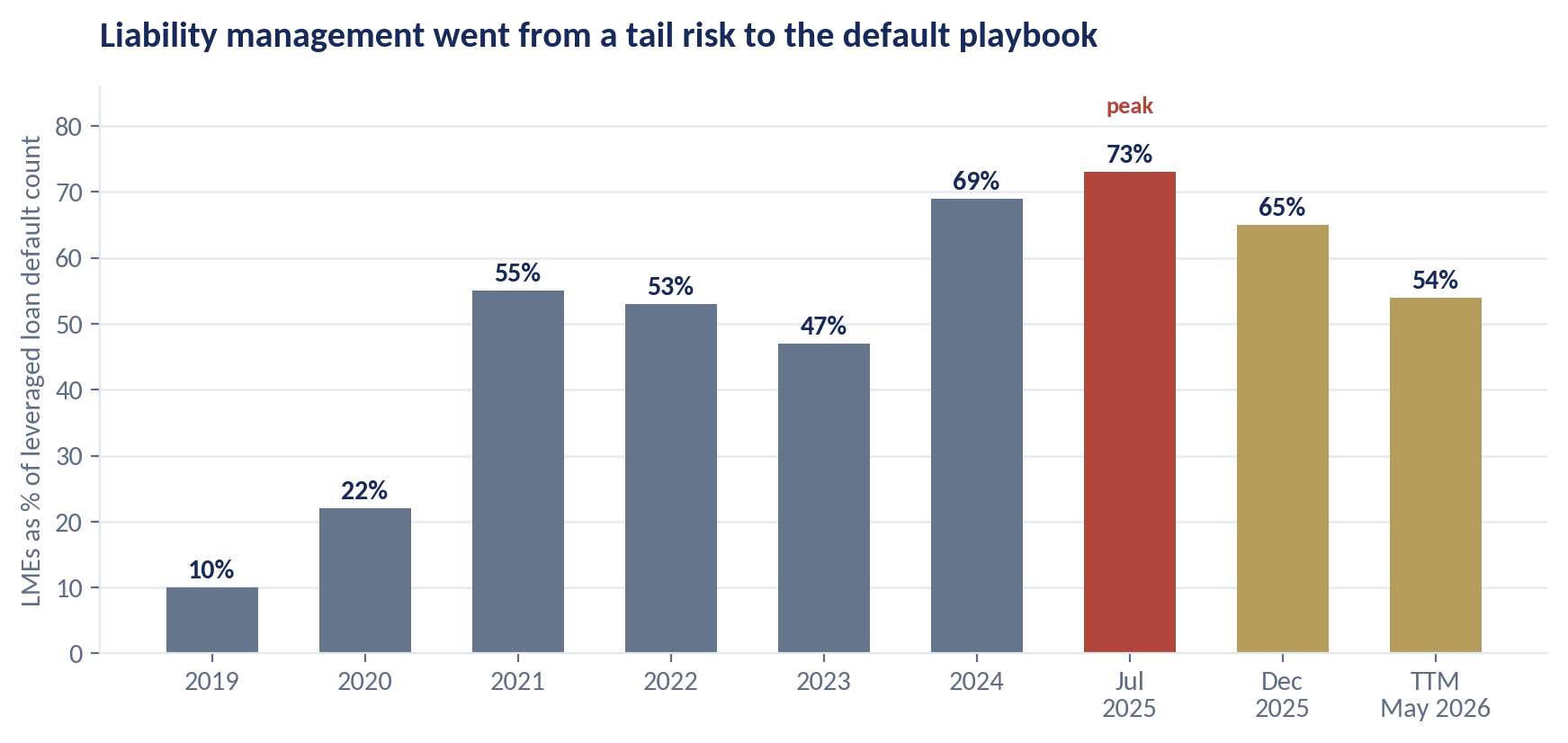
Passivity now means subordination. Liability management exercises accounted for 10% of leveraged loan default events in 2019. They peaked at 73% in July 2025 and still ran at 54% over the twelve months to May 2026. Moody's finds that about one in four such restructurings ends in a hard default and more than one in three ends in a hard default or a further credit event, with more than 70% of those failures arriving inside two years. The 2023 and 2024 restructuring cohort is inside that window now.4
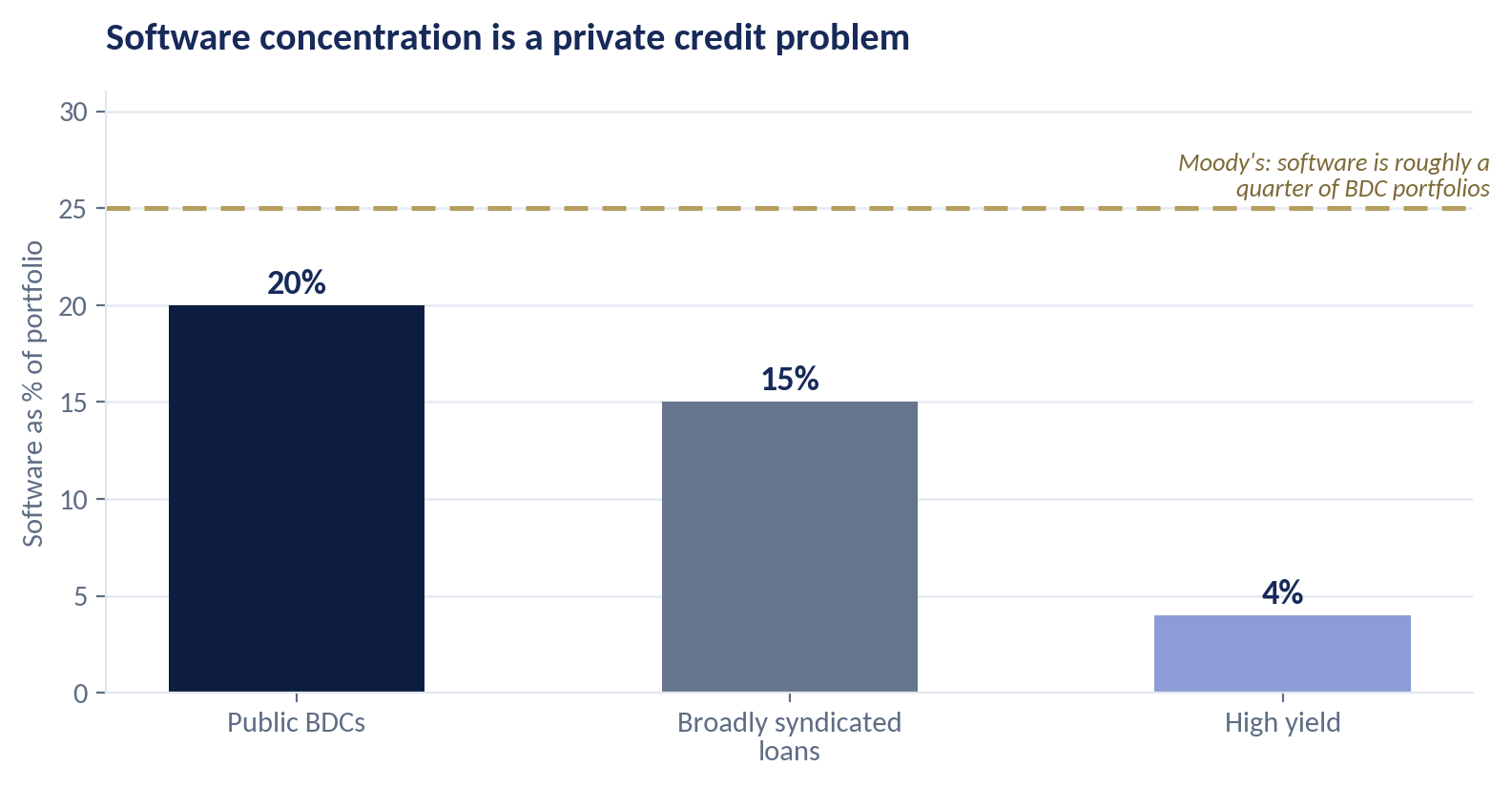
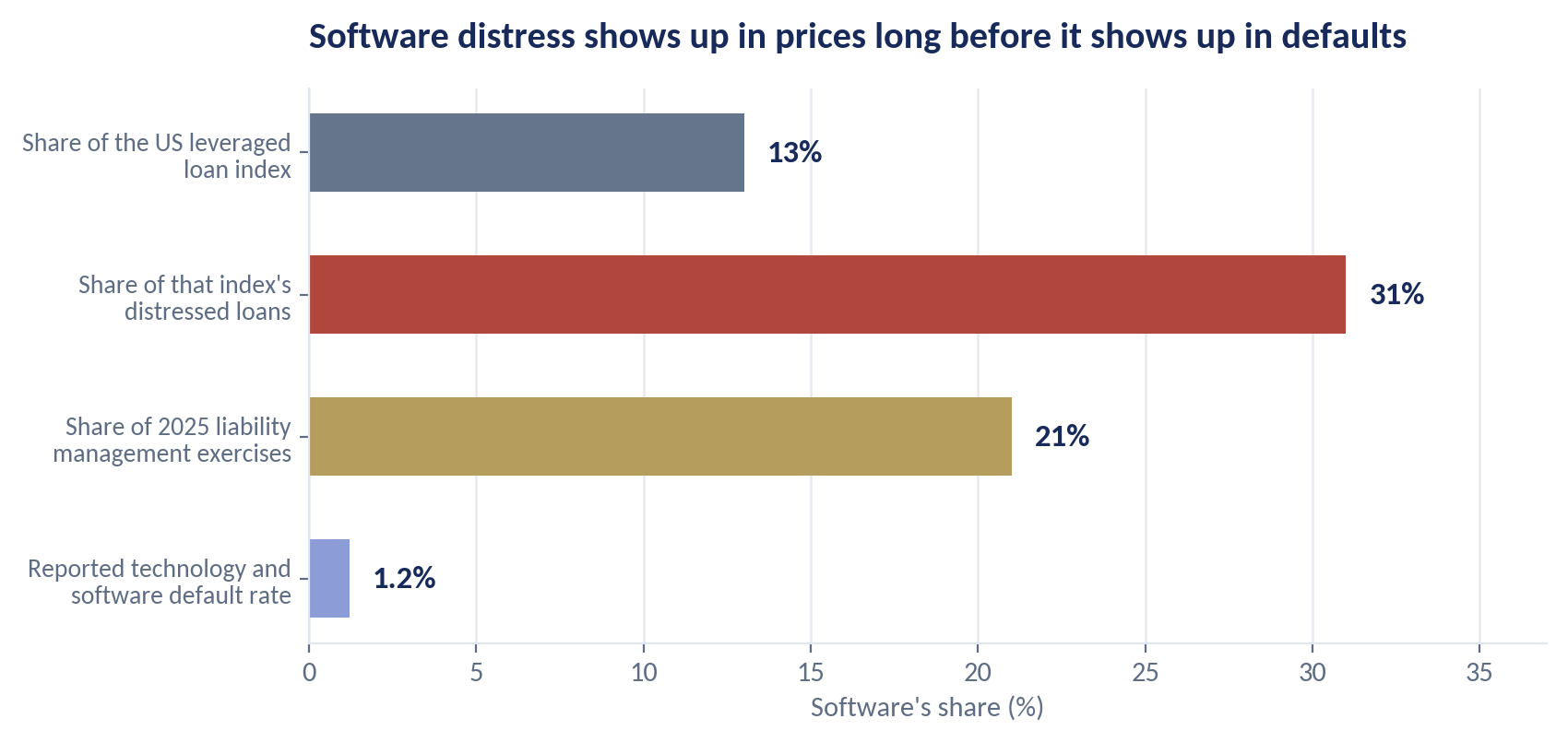
The exposure sits exactly where the disruption is. Lending to software grew from under $8B in 2015 to more than $500B by the end of 2025, about 19% of all direct loans, and roughly a third of private credit funds have written a SaaS loan. Software is about 20% of BDC assets against 15% in broadly syndicated loans and 4% in high yield, and Moody's puts it closer to a quarter of the median BDC book. Software is 13% of the US leveraged loan index and 31% of that index's distressed loans, yet its reported default rate is the lowest of any large sector at 1.2%. The stress is in the prices, not yet in the defaults.5
The cases are no longer hypothetical. Medallia's lenders closed their takeover of the business on August 3, 2026, after Blackstone declined to extend PIK relief and forced a cash-or-keys decision, wiping out roughly $5.1B of sponsor equity in Thoma Bravo's largest write-off. Pluralsight, restructured in 2024, went back on non-accrual at several BDCs in the fourth quarter of 2025. Taking the keys is not the finish line. Without operating capability, a lender-to-owner conversion simply relocates the loss.
This is an opportunity, not only a risk. The same stress that impairs the unprepared creates entry points for the prepared: rescue financings, discounted secondary paper, and lender-to-owner conversions of cash-generative businesses bought at a fraction of replacement cost. Loss avoidance and opportunistic gain are two faces of one capability. Oaktree, Ares, Apollo, TPG and Bain have all funded that capability as a dedicated strategy with its own mandate, talent and decision rights. Most middle-market lenders will not build all of it, which is why the closing section sets out how it can be bought in stages.
2. Market backdrop and the credit cycle
2.1 SaaS was the ideal private credit borrower
Software was not a reckless bet. For most of the last decade it was, defensibly, the ideal private credit borrower. Outstanding loans to SaaS firms grew from almost $8B in 2015 to over $500B, or 19% of total direct loans, by the end of 2025. A third of private credit funds have extended loans to the sector, and BDCs directed more than 15% of their 2025 loan issuance to it.6
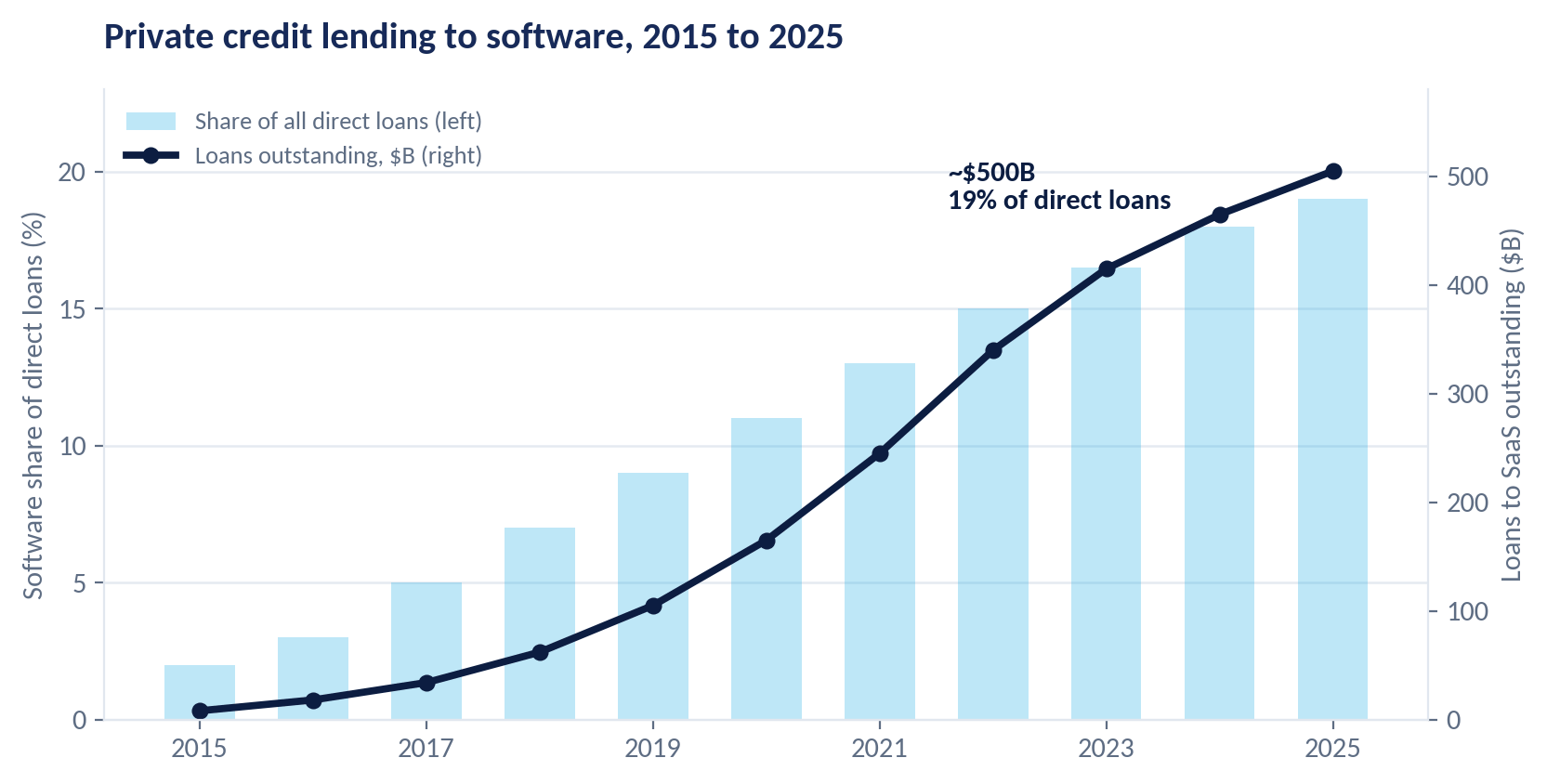
Four pillars made the model work, and each was a genuine credit strength while it held.
| The four pillars | Why it made SaaS ideal collateral for a lender |
|---|---|
| Predictable recurring revenue | Long contracts and subscription renewals produced visible, underwritable cash flow; enterprise value was underwritten on a revenue multiple. |
| High customer retention | Sticky seats and low logo churn, with net revenue retention above 110% in healthy books, implied a durable revenue base. |
| Scalable margins | Fixed-cost economics meant that once the product was built, incremental revenue dropped largely to gross profit. |
| High switching costs | Integrations, training, and data lock-in built a moat that protected the revenue base across the term of the loan. |
2.2 Higher-for-longer rates and AI broke the SaaS credit model
Two forces, not one, broke the model. Rates repriced the debt; AI is repricing the revenue. Higher rates moved enterprise value from a revenue multiple to an EBITDA multiple and broke the refinancing math. AI labor deflation compressed seat-based demand, replaced fixed-cost economics with variable inference and GPU cost, and let agents rebuild replacement functionality faster than the contract term renews. The damage is structural rather than cyclical, so it does not reverse when the Fed eventually cuts.
| The four pillars | How each pillar broke |
|---|---|
| Predictable recurring revenue | Higher rates discount future revenue. Emphasis shifts from growth to profitability, enterprise value moves from a revenue multiple to an EBITDA multiple, and the refinancing math no longer holds. |
| High customer retention | AI labor deflation compresses seats. The unit of work shifts from seats to consumption, and consumption is variable. |
| Scalable margins | Variable cost of goods sold replaces fixed-cost economics. Inference, tokens and GPU cost sit underneath every customer interaction. |
| High switching costs | Agents rebuild replacement functionality in parallel. The moat shrinks faster than the contract term renews. |
The repricing is visible in every valuation series. The Bessemer cloud index traded at roughly 28 times revenue at the end of 2021 and at 6.3 times in June 2026. Software equities collapsed by almost 30% between October 2025 and February 2026. Of 55 listed SaaS companies, only 15% clear the Rule of 40 on an EBITDA basis, with a median score of 22.6%, and median private B2B SaaS growth has slipped to 22% in 2026 from 25% in 2024.7
One part of the AI thesis deserves qualification, and this paper makes it explicitly. The cost side is proving more manageable than the revenue side. ICONIQ's January 2026 survey of roughly 300 software executives found blended gross margins recovering to a projected 52% in 2026 from 45% in 2025 and 41% in 2024, with inference the second-largest line of AI product cost at scaling-stage companies, at about 23% behind talent at 26%. Inference cost is a real drag, but it is falling and it is being engineered around. The demand-side question, whether a seat-based contract survives an agent that does the same work, is the harder one, and it is the one that determines terminal value.8
2.3 The market has split into four credit regimes
The same two forces split the software credit universe into four regimes. Where a loan sits now drives its recovery, not its original underwriting. The discipline that follows is to underwrite the quadrant a loan occupies today, and to reprice and reserve against the dual-headwind cohort before the maturity wall forces the issue.
| Debt-service stress | Low AI displacement risk | High AI displacement risk |
|---|---|---|
High (rate squeeze) |
Rate squeeze. High leverage, lower AI risk. Private equity add-on roll-ups with complex capital structures and acute rate sensitivity; mid-market ERP and back-office, sticky but rate-sensitive with a tight refinancing window; niche content and creative tools where AI slowly erodes differentiation. | Default corridor. Most at risk. Dual headwind of rates and AI. Horizontal per-seat SaaS of the 2021 buyout vintage, covenant-lite with declining net revenue retention; project and task management facing seat erosion from agents; document automation and e-signature point solutions against the 2026 to 2028 wall; SMB CRM and marketing automation exposed to discretionary point spend. |
| Low | Durable collateral. Defensible loans, stable recovery. Mission-critical vertical SaaS with a regulatory moat and deep workflow lock-in; cybersecurity, non-discretionary with strong retention; data infrastructure and observability, usage-based with an AI demand tailwind; compliance and RegTech, mandate-driven and low displacement. | Structural watch. Model disruption, manageable debt. Entrenched low-leverage CRM; customer support and ticketing where agents replace tier-one work; HR and workforce management facing AI payroll risk and an outcome-based pivot; AI-native and outcome-based models, the new lending frontier. |
2.4 Portfolios are concentrated in the most exposed sectors
The exposure problem is acute because the disruption is concentrated where the capital is. Software is roughly 20% of BDC portfolios against 15% of broadly syndicated loans and 4% of high yield, and Moody's puts software at roughly a quarter of the median BDC book. When Moody's cut its outlook on the $400B BDC sector to negative in April 2026, software concentration was one of the three reasons it gave, alongside redemption pressure and weakening access to funding markets.9
Lenders have begun to react, but slowly and late. Technology fell to 14% of new direct-lending deal count in the first quarter of 2026 from 18% across 2025, with healthcare overtaking it. New origination discipline does nothing for the book already written.10
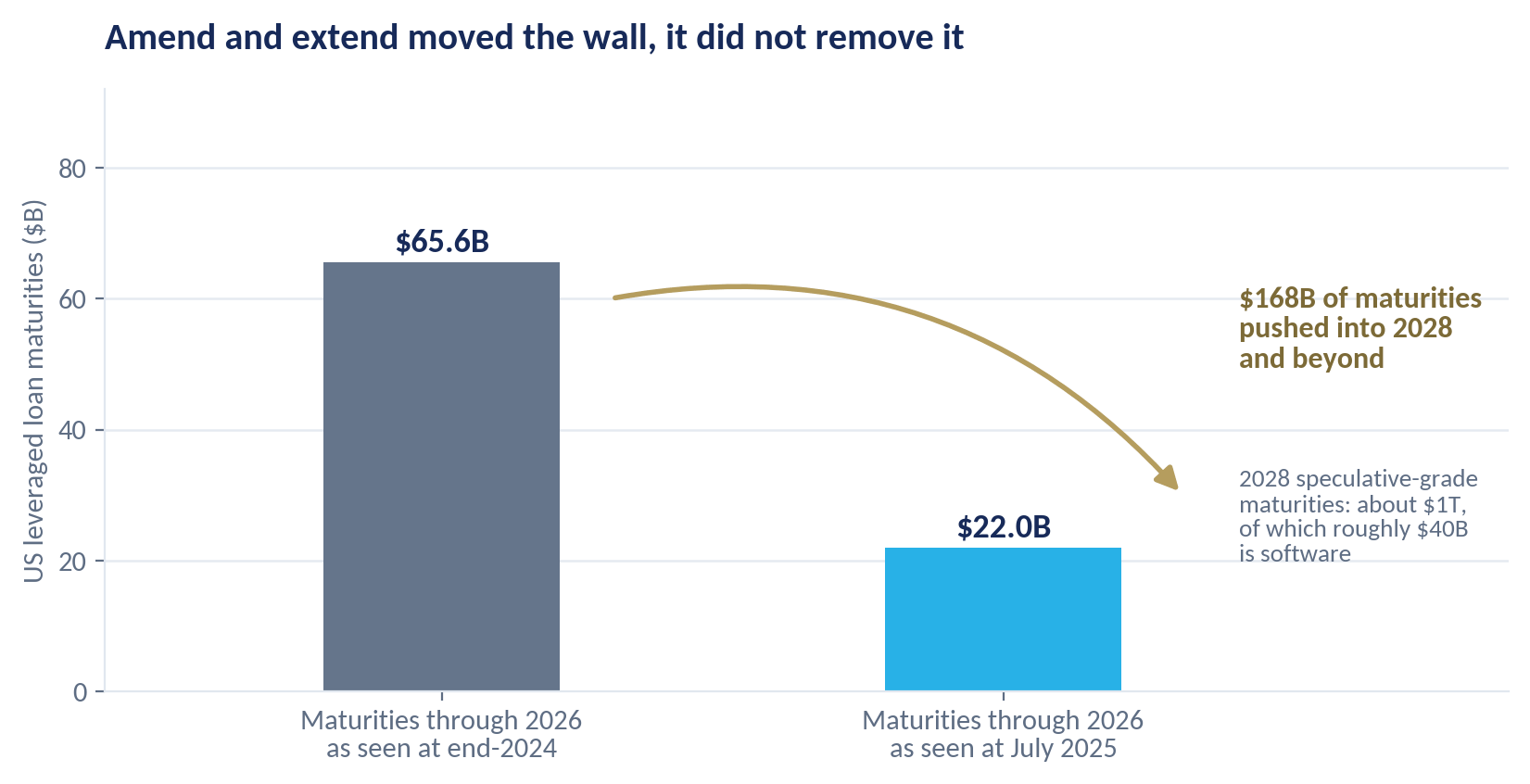
A refinancing wall compounds the concentration, and it has moved rather than shrunk. Amend-and-extend activity cut loan volume maturing through the end of 2026 to $22.0B by July 2025, down from $65.6B at the end of 2024, while adding $168B to loans coming due in 2028 and beyond over the same period. Roughly $1T of speculative-grade debt now comes due in 2028, of which about $40B is software, and Moody's estimates that roughly 40% of outstanding software-sector loans mature in the 2028 to 2029 window.11
Refinancing options are also narrower than in prior cycles. Bank commercial and industrial standards were broadly unchanged in the July 2026 Senior Loan Officer survey after tightening earlier in the year, and software companies, with little hard collateral, are among the least natural fits for a bank balance sheet. The next 18 months, not the next quarter, are when persistent rates, disguised distress and the wall collide for the most exposed sector in the book.12
2.5 Convergence is creating the perfect storm
Each force alone would warrant attention. A contracting cycle, higher-for-longer rates, a 2028 maturity wall, and an AI shock concentrated in the largest portfolio sector arrive together. They define an environment in which the probability and the clustering of stressed credits rise sharply at precisely the moment refinancing options narrow. In a software default there is no collateral to seize and no quiet liquidation to fall back on. The lender must be ready to take the keys and run the business, or accept a write-off.
The headline default rate is misleading, and the gap between measures is the signal. Proskauer's index of 716 loans put private credit defaults at 2.51% in the second quarter of 2026, down from 2.73% in the first. KBRA's direct-lending measure ran at 2.3% and matched its index-inception peak. Fitch's broader measure, which counts the distressed exchanges and maturity extensions the narrow indices exclude, hit a record 6.0%, on 32 default events involving 20 new defaulters, more than half of which were maturity extensions rather than missed interest.13
Nowhere is the measurement gap wider than in software. Software is 13% of the Morningstar LSTA US leveraged loan index and 31% of that index's distressed loans. It accounted for 21% of all liability management exercises in 2025. In January 2026 the volume of software facilities trading below 80 cents on the dollar more than doubled in a single month to a record $25B, and the wider technology distressed pile reached about $46.9B. Over the same period Fitch reported the technology and software default rate at 1.2%, the lowest of any large sector and down from 2.3%. Both facts are true. Only one of them is forward-looking.14
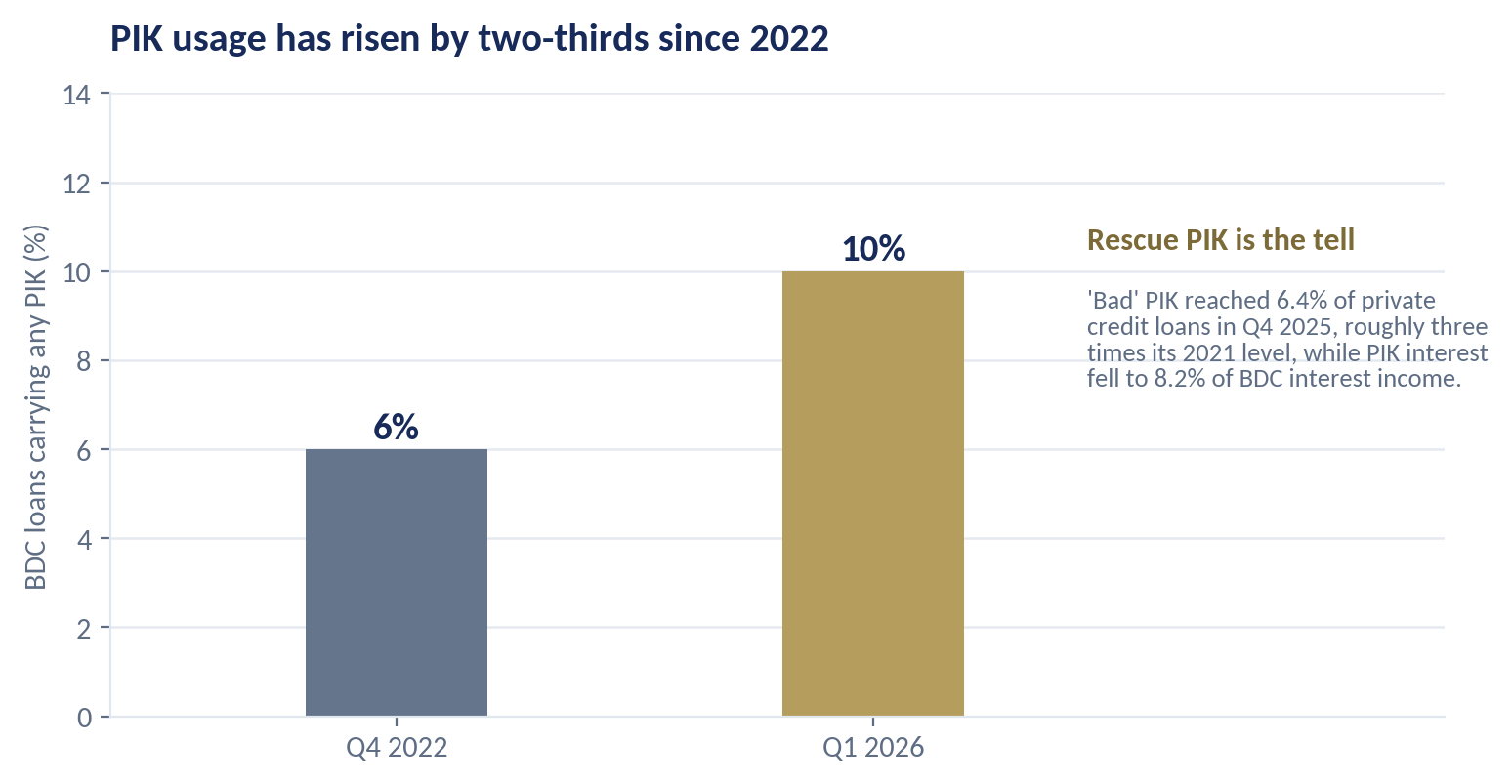
The most reliable single tell is payment-in-kind, and the level matters less than the composition. Good PIK is negotiated at origination as a deliberate structuring choice for a healthy borrower. Bad PIK is negotiated after origination to rescue a borrower that cannot pay cash interest, a leading indicator of distress dressed up as income. The share of BDC loans carrying any PIK rose from about 6% in the fourth quarter of 2022 to about 10% by the first quarter of 2026, a two-thirds increase, and rescue PIK reached 6.4% of private credit loans in the fourth quarter of 2025, roughly three times its 2021 level. PIK interest as a share of BDC interest income has meanwhile edged down to 8.2%, which reflects lenders refusing to extend relief rather than borrowers no longer needing it. That is precisely what happened at Medallia.15
There is a further constraint that did not exist in the last cycle: the lender's own liability side. Non-traded vehicles, which are more than 60% of the BDC sector, recorded their first-ever outflows at the start of 2026, and sector redemption requests rose to 4.8% of net asset value in the fourth quarter of 2025 from 1.6% in the third. A manager facing redemptions has less freedom to be patient with a stressed credit than one that is not. Patience has become expensive at exactly the moment it stopped working.16
2.6 Three capabilities decide recovery
Alpha in credit is generated during contractions by minimizing losses, and delay destroys value. The lender needs to see stress early, know what the credit can actually recover, and possess the capability to act on the answer. Three pillars follow, and they organize the rest of this paper.
- Early-warning systems that flag stress 12 to 18 months before payment default, using the operating metrics that actually predict distress in asset-light businesses rather than the lagging financial covenants that do not.
- Tailored action plans calibrated to SaaS and asset-light dynamics, where value runs off in real time and a court-led process recovers little, so the playbook must engage sponsors early and move in weeks.
- The capability to act, spanning the full set of roles a stressed credit demands: lender, restructuring principal, rescue financier, operational owner, and control investor. It has to exist on the credit before the credit needs it.
Detection, underwriting and capability together are a durable source of alpha and, on a concentrated software book, the difference between a managed outcome and a write-off. The next section diagnoses where most platforms fall short; Section 5 specifies what to do about it.
3. Diagnostic: three gaps leave recovery on the table
The same three capabilities that decide recovery are, in most platforms, the three areas of greatest weakness. The gaps are structural, not a matter of individual diligence, which is why they persist across otherwise well-run firms. Between the second and third gap sits a fact that turns a playbook problem into a capability problem: for a large part of the software book, default has no exit.
3.1 Gap 1. Defenses are down: an ineffective early-warning system
Thesis. Covenant-lite structures and quarterly, self-reported financials make distress visible only after recovery options have narrowed.
- Covenant-lite is concentrated where the software credits are. More than 90% of large-cap broadly syndicated loans are covenant-lite. Private credit has held the line better than the syndicated market but is moving the same way: covenant-lite rose to 21% of private credit deals in 2025 from 4% in 2023. Crucially, the erosion is concentrated at the top of the market. Proskauer finds that 91% of covenant-lite private credit deals involve borrowers with $50M or more of EBITDA, which is exactly where the large sponsor-backed software credits sit. The protection largely holds in the lower middle market and is thinnest precisely where the exposure is.17
- Venture and ARR lending is lighter still. Loans to pre-profit software borrowers are underwritten on ARR and liquidity tests rather than EBITDA maintenance covenants, so a missed payment, not a covenant trip, is often the first formal signal.
- Reporting arrives stale. Quarterly borrower financials typically reach the lender six to eight weeks after quarter-end, so the data is already old when it lands, and covenant-lite deals rarely compel anything faster.
- PIK was misread as benign. The market treated rising PIK as yield enhancement when much of it was rescue PIK. Boston Fed research now uses PIK usage explicitly as an early-warning indicator, and finds the share of BDC loans carrying it up by two-thirds since 2022.
- Marks confirm rather than predict. The Financial Stability Board notes that private credit valuations are updated infrequently, usually quarterly, which is adequate in normal conditions and less so under stress, and warns that stale marks create a first-mover incentive to redeem. The evidence is in the numbers: across the largest BDCs, performing tranches were carried at 98.8% of cost in the first quarter of 2026 while non-accrual debt was carried at 55.8%, a 43-point gap that opens only after a hard event.
3.2 Gap 2. The patient-lender playbook was written for steel mills, not SaaS
Thesis. The traditional patient-lender approach assumes a depreciating but durable asset. In SaaS the asset depreciates by itself while the lender waits.
| Dimension | Hard-asset borrower | Asset-light borrower (software and services) |
|---|---|---|
| What the asset is | Plant, property and equipment: physical, securable, with residual value | Recurring revenue generated by customer relationships, code and talent |
| Behavior under stress | Durable; depreciates gradually | Organic and volatile; can evaporate quickly |
| How value is lost | Orderly: the asset sits on the floor while you negotiate | Compounding: customers churn, employees leave, revenue runs off in real time |
| What security gives you | Residual value you can seize, hold and sell | A legal claim on something that may not exist by the time you act on it |
| Best alternative at default | Liquidate the collateral; there is a floor on recovery | None. The asset is a team and a customer book, and neither can be liquidated |
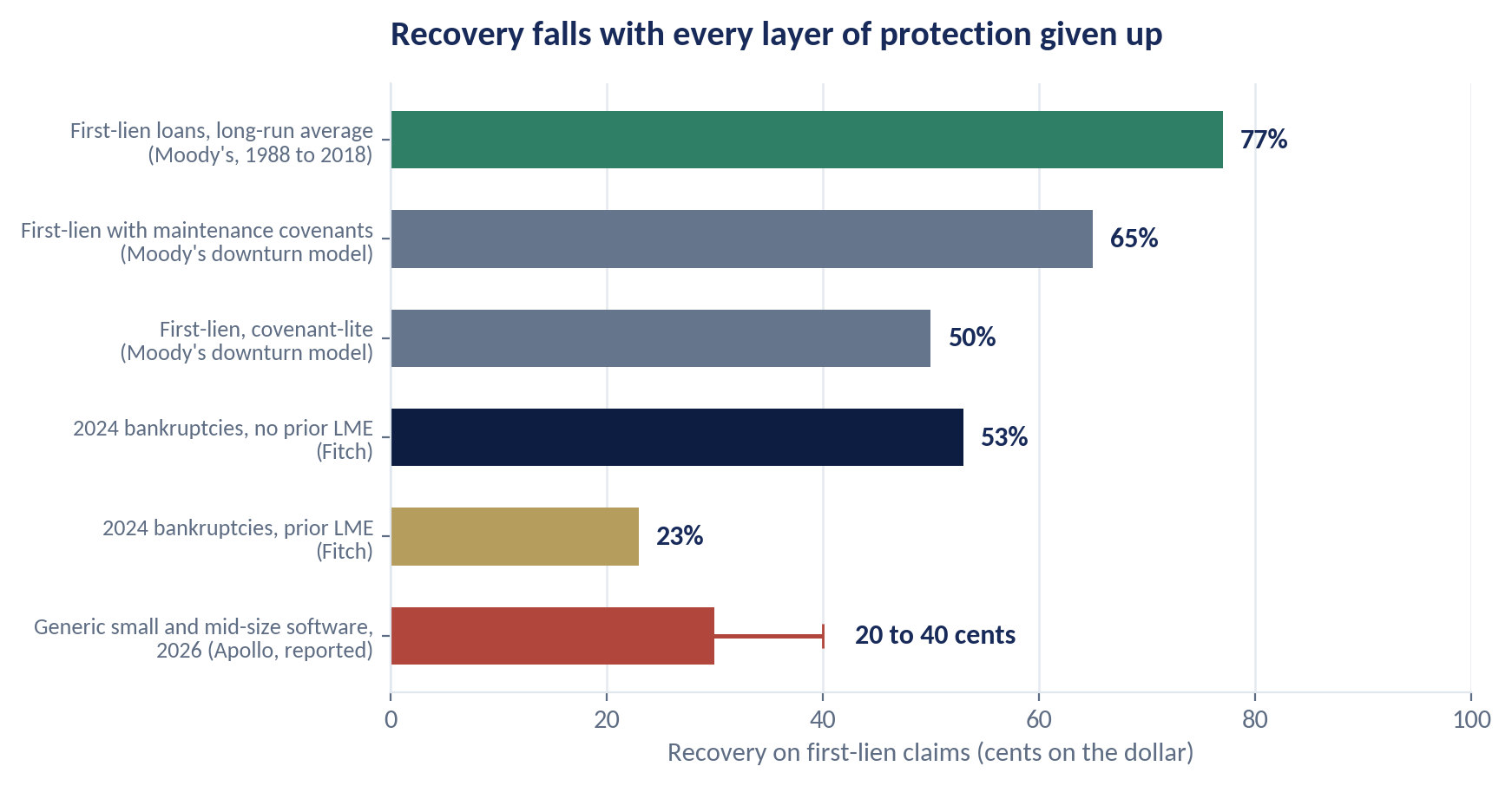
The recovery data has caught up with the argument. Moody's long-run average recovery on first-lien loans was 77% over 1988 to 2018, and its own downturn model put covenanted first-lien structures at 65% against 50% for covenant-lite. Fitch found first-lien recoveries in 2024 bankruptcies of 53% where there had been no prior liability management exercise and 23% where there had been. For a generic small or mid-size software company in 2026, Apollo's John Zito has put the realistic range at 20 to 40 cents on the dollar. The direct-lending assumption of 75 cents and better, which held for most of the asset class's history, no longer describes the asset-light tail of the book.18
Two findings should end the case for waiting. First, speed pays: using S&P Global's LossStats database from 1987 to 2023, distressed exchanges recovered an average of 79%, while bankruptcies lasting under six months recovered 60% and those running one to three years recovered 48%. Second, extension is not resolution. Moody's study of 1,173 borrowers finds that about one in four distressed restructurings ends in a hard default, more than one in three ends in a hard default or a further credit event, and more than 70% of the eventual hard defaults occur within two years of the restructuring. Moody's conclusion is blunt: borrowers restructured in 2023 and 2024 are entering their most vulnerable window now.19
3.3 In default, there is no exit
For a software business below the Rule of 40 and exposed to AI substitution, a buyer of last resort may not exist. This is where a playbook problem becomes a capability problem, and it is the single fact that most changes what a lender should do in the twelve months before a default rather than after it. A company gets one credible sale process. Run it from a position of distress and every later process starts from the broken-process discount.
No strategic buyer
Acquirers wait for the carcass. There is little reason to pay for a declining, AI-exposed seat business that agents can replicate. The rational strategic move is to extract the data and the customers and then bid low, if at all.
No sponsor bid and no refinancing
Below the Rule of 40 the equity is already written off internally, and sponsors will not re-invest into a position they have marked to zero. Higher-for-longer has closed the refinancing window, and banks are not a natural home for a business with no hard collateral. The capital structure has nowhere to roll.
No auction tension
Once default is in the air, a three-month process stretches past six. Talent leaves and ARR churns in real time, so the asset shrinks while it is being marketed. The cost of delay is not a figure of speech in an asset-light business; it is the difference between the bid you could have had and the bid you will get.
3.4 Gap 3. Most platforms are staffed to originate, not to recover
Thesis. Most private credit platforms are staffed to originate, not to recover. The team that underwrote the deal is the team least able to declare it impaired.
- Dedicated workout teams are the exception. Outside the largest platforms, few middle-market lenders run a workout function that is organizationally separate from origination.
- Extend and pretend. Covenants are waived and maturities extended without solving the business problem, which magnifies the eventual loss. The Moody's recidivism data in Section 3.2 prices that choice.
- Restructuring muscle arrives late. Many firms retain restructuring expertise only after the first default, once leverage has already shifted to the sponsor.
- Weak posture loses the table. Against no credible workout threat, the sponsor's equity-first plan tends to prevail. Documentation is now the battleground: 2025 saw at least 13 attempts to insert anti-cooperation provisions at syndication, of which three succeeded, and in September 2025 the US District Court for the Southern District of Texas reversed the ConvergeOne plan confirmation on equal-treatment grounds under section 1123(a)(4), putting a check on exclusive-opportunity structures without removing the incentive to try them.
- It compounds into subordination. Liability management has gone from a tail risk to the default playbook, and a lender without the capability to act is the lender who gets primed.
- No operating capability. Without operating partners and interim executives, a firm can restructure the debt but cannot arrest the operating decline. Section 4 shows what that costs.
The market is beginning to price the difference. Cambridge Associates argued in April 2026 that the unusually narrow dispersion of the 2014 to 2022 direct-lending vintages masked genuine differences in manager skill, that dispersion should now widen, and that managers with experienced workout capability and early-intervention discipline are positioned to separate from the field. There is no controlled study proving that workout-equipped lenders realize lower losses, and this paper does not claim one. What exists is a consistent direction of travel across rating-agency recovery data, allocator commentary and the hiring market for restructuring talent.20
4. Case evidence: Pluralsight, Medallia, and what happened next
Two publicly reported software workouts bracket the range of outcomes, and a third data point, the sequel to the first, completes the argument. The contrast is not luck. It is structure, protection, and the capability to run a business once you own it.
Pluralsight: the cautionary tale of an exposed lender
Pluralsight, the developer-skills platform Vista Equity Partners took private at roughly $3.5B in 2021, became a landmark warning. Before handing the business to creditors, Vista moved intellectual property into a separate subsidiary and provided about $50M of financing against it, a maneuver that echoed the J. Crew trapdoor of 2016 and that lenders across the market immediately began drafting against. In August 2024 the lender group took roughly 85% of the equity through a debt-for-equity swap that eliminated about $1.2B of debt against roughly $275M of new money, and Vista and its co-investors wrote off approximately $4B. The lesson is not that the lenders failed to recover. It is that value left through a door the documentation left open.21
Medallia: value preserved through an orderly handover
Medallia, the customer-experience software firm Thoma Bravo took private for $6.4B in 2021, ran the opposite course. By 2026 the company carried roughly $2.8B of private credit debt against about $200M of earnings and roughly $300M of annual debt service. The trigger was clean and instructive: when the 400 basis point PIK component expired at the end of 2025, a lender group led by Blackstone declined to extend further relief and told the company to pay cash interest or hand over the keys. Thoma Bravo agreed to an out-of-court debt-for-equity swap on April 22, 2026, announced a milestone agreement on June 17, and closed the transaction on August 3, 2026. Roughly $5.1B of sponsor equity was wiped out, among the largest single equity losses of the post-pandemic software buyout boom.22
What made Medallia orderly was structure. A small group of aligned first-lien private credit lenders negotiated bilaterally, with no priming, no uptier and no creditor-on-creditor litigation, because the loan sat with a handful of funds rather than fifty syndicated holders and CLOs whose indentures cannot hold equity. Kirkland & Ellis advised the company and Latham & Watkins the creditor group. The sponsor equity was a total loss, but the lenders converted their claim into ownership of a business they can run for value, committed $150M of new capital at closing, kept the chief executive in place, and have continued the product roadmap. The same loan in the broadly syndicated market would have produced litigation and value destruction.
The sequel: Pluralsight, two years on
Taking the keys is not the finish line, and Pluralsight is the proof. The 2024 debt-for-equity swap handed control to a lender group with capital and legal capability but no obvious operating mandate. By the fourth quarter of 2025 Pluralsight debt was back on non-accrual at multiple BDCs, and coverage through the first quarter of 2026 describes a 2024 restructuring at risk of unraveling. This is exactly the pattern Moody's identified in May 2026: one in four distressed restructurings ends in a hard default, more than 70% of those within two years, and the 2023 to 2024 cohort is inside that window now.23
The comparison below is the argument of this paper in one table. Two sponsors, two sets of documents, two lender postures, and a third column that shows what happens when a lender wins the restructuring and then has nothing to do on Monday morning.
| Dimension | Pluralsight (cautionary) | Medallia (the model) |
|---|---|---|
| Sponsor | Vista Equity Partners | Thoma Bravo |
| Pre-workout maneuver | About $50M of intellectual property moved into a separate subsidiary, beyond the original collateral package | None. The year-end 2025 PIK relief simply expired |
| Lender posture | Reacted after value had already leaked | Engaged early and forced a cash-or-keys decision |
| Process | Contested and documentation-driven | Noncontentious and out of court |
| Creditor alignment | Broad group across multiple structures | A small group of aligned first-lien private credit lenders |
| Outcome for lenders | Took about 85% of the equity after a $1.2B debt cut and about $275M of new money, August 2024 | Took ownership of a profitable business with $150M of new capital, closed August 3, 2026 |
| What happened next | Back on non-accrual at multiple BDCs by Q4 2025; the restructuring is under strain | Chief executive retained, roadmap continued, deleveraged balance sheet |
| Lesson | Close the trapdoor in the documents, and own the operating plan before you own the company | Bilateral senior control plus early action enables an orderly handover |
Medallia is a preview rather than an exception. Analysts have identified more than a dozen private-equity-owned SaaS businesses carrying upwards of $50B of debt in comparable positions as the 2028 wall approaches, and separately about $46.9B of technology debt trading at distressed levels. The lesson for the lender is to sort the book now. Some credits are vertical-SaaS businesses with sticky contracts and limited near-term AI substitution, and those may refinance or amend and extend through the wall. Others are horizontal tools solving a generic problem that AI also solves, where terminal value is already in question. Those will not amend their way out, and for them an early, orderly handover preserves more value than waiting, provided the lender can actually run what it takes.24
5. Where recovery is won
The diagnosis maps directly to three actions: see it earlier, underwrite the recovery, and have the capability to act on it. Each requires a shift in how a private credit firm understands its own role, from passive holder to active owner of the recovery, and each shift demands one concrete fix.
5.1 Three shifts in mindset, and the fix each demands
| From | To | The fix | |
|---|---|---|---|
| 01 | Passive monitoring | Active operating intelligence | A standing watch. Continuous monitoring tied to triage flags stress 12 to 18 months before default. |
| 02 | Delayed action, the patient creditor | Pre-default intervention | An underwritten recovery. The four straight answers before a process starts, rather than after one fails. |
| 03 | Bank-like passivity | Equity-like decision-making | The capability to act. Operating capability, rescue capital and a credible bid, in place before the first credit turns. |
5.2 A standing watch, tied to triage
Thesis. Monthly KPI surveillance with negotiated data rights compresses detection lag from a fiscal quarter to a calendar week. Monitoring without triage is just data.
The standing form of this is a portfolio watch: a quarterly screen across the watchlist, aligned to the reporting calendar, run on the reporting the lender already holds. It requires no borrower contact, designates no name and signals nothing to the market. Its output is a short list of the credits that can actually sell, ranked by what an early start is worth. Everything in this section is what that screen triggers.
What to watch
- Account-level surveillance. Direct visibility into borrower bank and collection accounts, so cash generation is visible in near real time rather than six to eight weeks after quarter-end.
- Always-on covenant and concentration testing. Key metrics tested against contractual thresholds continuously, with both sides notified before a breach occurs rather than after it.
- Operational performance metrics. In addition to maintenance covenants, the operating measures that actually predict distress in an asset-light business.
- The portfolio, not just the credit. A cross-portfolio watch surfaces clustering risk, for example five borrowers losing top-ten customers to the same AI-native entrant in one quarter.
Negotiate the access at origination, not later: read-only access to the billing system, general ledger and HR system, with standardized monthly KPI delivery within five business days of month-end. Data rights are cheap to ask for at signing and impossible to obtain once a borrower is stressed.
The four signals that trigger escalation
- Free cash flow against debt service. Alert when free cash flow is negative for two or more consecutive quarters.
- Net revenue retention. Alert when retention falls below 95%, or declines for three consecutive quarters.
- Sales efficiency. Alert when the magic number falls below 0.5, or customer-acquisition payback exceeds 24 months.
- Refinancing runway. Alert at less than 18 months to maturity with a Rule of 40 score below 20.
The call
| Status | What it looks like | Required action |
|---|---|---|
Green Performing |
Growth on or above plan; net revenue retention above 110%; Rule of 40 in range | Protect and hold. Quarterly review only. |
Yellow Watch |
Growth 10 to 20% below plan; retention 95 to 110%; refinancing due within 18 months | Monthly portfolio-manager cadence, sponsor dialogue within two weeks, scenario plan drafted. |
Red Distress |
Growth severely below plan; retention below 95%; refinancing unviable; sponsor will not inject equity | Trigger the sponsor conversation, engage the workout team within 30 days, prepare the 90-day sequence. |
The four signals above are the triggers. The dashboard behind them carries six measures, each with a defined threshold, so that escalation is automatic rather than discretionary.
| Metric | Green | Yellow | Red | Required action |
|---|---|---|---|---|
| Net revenue retention | 110% or better | 100 to 110% | Below 100% | Sponsor dialogue at yellow; reforecast at red |
| Gross revenue retention | 92% or better | 90 to 92% | Below 90% | Churn root-cause review |
| Magic number | 0.75 or better | 0.5 to 0.75 | Below 0.5 | Re-underwrite growth efficiency |
| Burn multiple | Below 1.5 | 1.5 to 2.0 | Above 2.0 | 13-week liquidity forecast |
| Rule of 40 | 40 or better | 30 to 40 | Below 30 | Refinancing-runway review |
| Top-10 customer concentration | Below 25% | 25 to 35% | Above 35% | Customer-retention deep dive |
Figure 9. The KPI escalation matrix. Source: Alary Capital.
This is not theoretical. Alary built and implemented an automated continuous portfolio-monitoring system of this design at Full In Partners, covering account-level cash visibility, always-on covenant testing and operating KPIs against thresholds.
5.3 A recovery sequenced in weeks, not quarters
Thesis. The right workout for an asset-light business protects the operating asset before it protects the lien. It moves in weeks, forces the sponsor's hand, and decides at a hard gate.
- Day 0 to 30, diagnose. Sponsor engagement, KPI deep dive, customer-concentration review, AI-displacement mapping of which line items face which agents, and a 13-week liquidity forecast.
- Day 30 to 60, plan. Roll the 13-week liquidity forward, build covenant-trajectory analysis, draft bridge-financing terms, and structure stay bonuses for key personnel.
- Day 60 to 90, decide. A hard decision gate across four paths: amend and extend, rescue financing, sponsor handoff, or take the keys. The rationale is documented either way and the bias is toward action.
- Protect the operating asset in parallel. Customer-success outreach to top-ten accounts, chief revenue and chief technology officer retention through stay bonuses, and product-roadmap continuity, running through all 90 days.
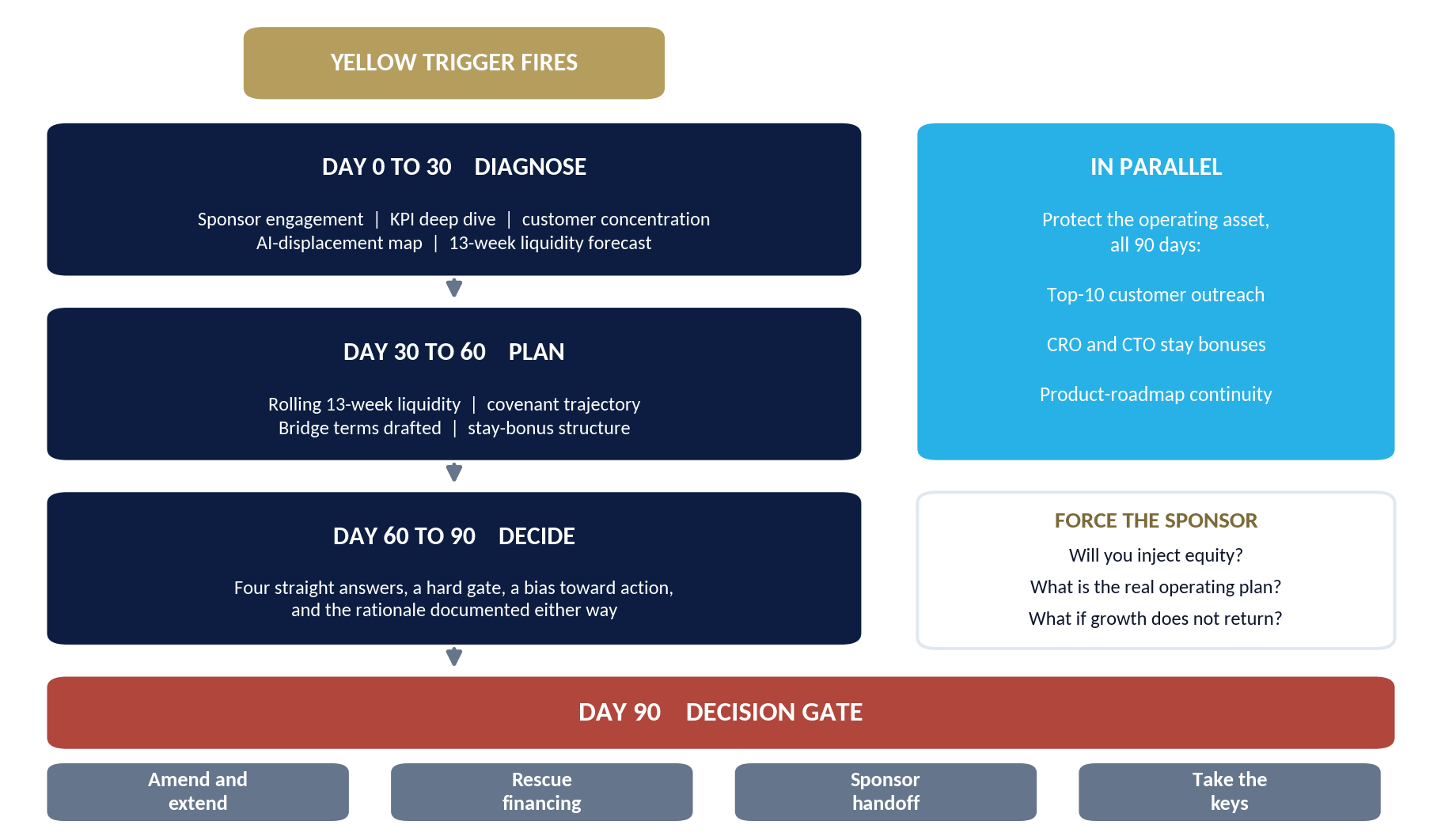
The gate turns on four straight answers: what the credit is worth, who actually buys it, what has to be fixed first, and how long that takes. Behind them sit the defect list priced in enterprise-value terms, a two-scenario recovery analysis measured against the recovery objective the lender sets, the cost of delay in the company's own numbers, and the supported valuation. Sometimes the honest answer is a no-go call, and a no-go comes with the options that remain: the fix list that would change the answer, a sale run as-is, or, where the company will not sell as a going concern, an honest salvage plan for the collateral.
Three questions force the sponsor conversation. First, will you inject additional equity? If the answer is no, the equity is already written off internally and the lender is now the at-risk capital. Second, what is the real operating plan? Demand three to five years with measurable milestones, and track revenue, gross margin and EBITDA against it. Third, what happens if growth does not return? Force the conversation about refinancing viability, sale timing and capital-structure flexibility now, not later.
5.4 The capability: built, or bought in stages
The best plan is worth little without the capability to execute it. Historically, the private credit firms that performed through stressed cycles combined underwriting discipline with restructuring, operational and control-investing capability. The coming cycle will reward firms that can move across five roles: lender, restructuring principal, rescue financier, operational owner, and control investor. This is not merely a workout desk; it is five functions, and they have to exist on the credit before the credit needs them.
- 1. Early warning and portfolio surveillance. Monthly liquidity forecasting, covenant-trajectory analysis, customer-concentration and churn monitoring, vendor-stress analysis, AI-disruption mapping and management-quality scoring. This is the engine that buys the 12 to 18 months of lead time.
- 2. Independent restructuring expertise. In-house command of Chapter 11, out-of-court restructurings, liability management, priming and debtor-in-possession financing, intercreditor disputes and distressed exchanges, reducing dependence on external counsel and improving negotiating leverage.
- 3. Operational turnaround capability. Operating partners, transformation and pricing specialists, AI-implementation experts and interim executives whose objective is enterprise stabilization, not recovery maximization alone. This is the function Pluralsight's owners did not have.
- 4. Control-investing infrastructure. The governance, board, incentive-design and operational playbooks to own companies, replace management, inject rescue capital and run post-reorganization businesses. Firms unable to take control become passive participants in value destruction.
- 5. Distressed-opportunity origination. Rescue financing, discounted secondary purchases, structured preferred, debtor-in-possession financing and post-reorganization equity, turning others' forced selling into entry points and generating equity-like returns when generalist capital retreats.
These capabilities are not cost centers. They generate measurable alpha through five channels: reduced realized losses from earlier intervention; better capital allocation that distinguishes a liquidity problem from a broken model; enhanced negotiating leverage against sponsors and competing creditors; the ability to capture equity upside through lender-to-owner transitions; and superior triage that directs rescue capital only where it earns its return.
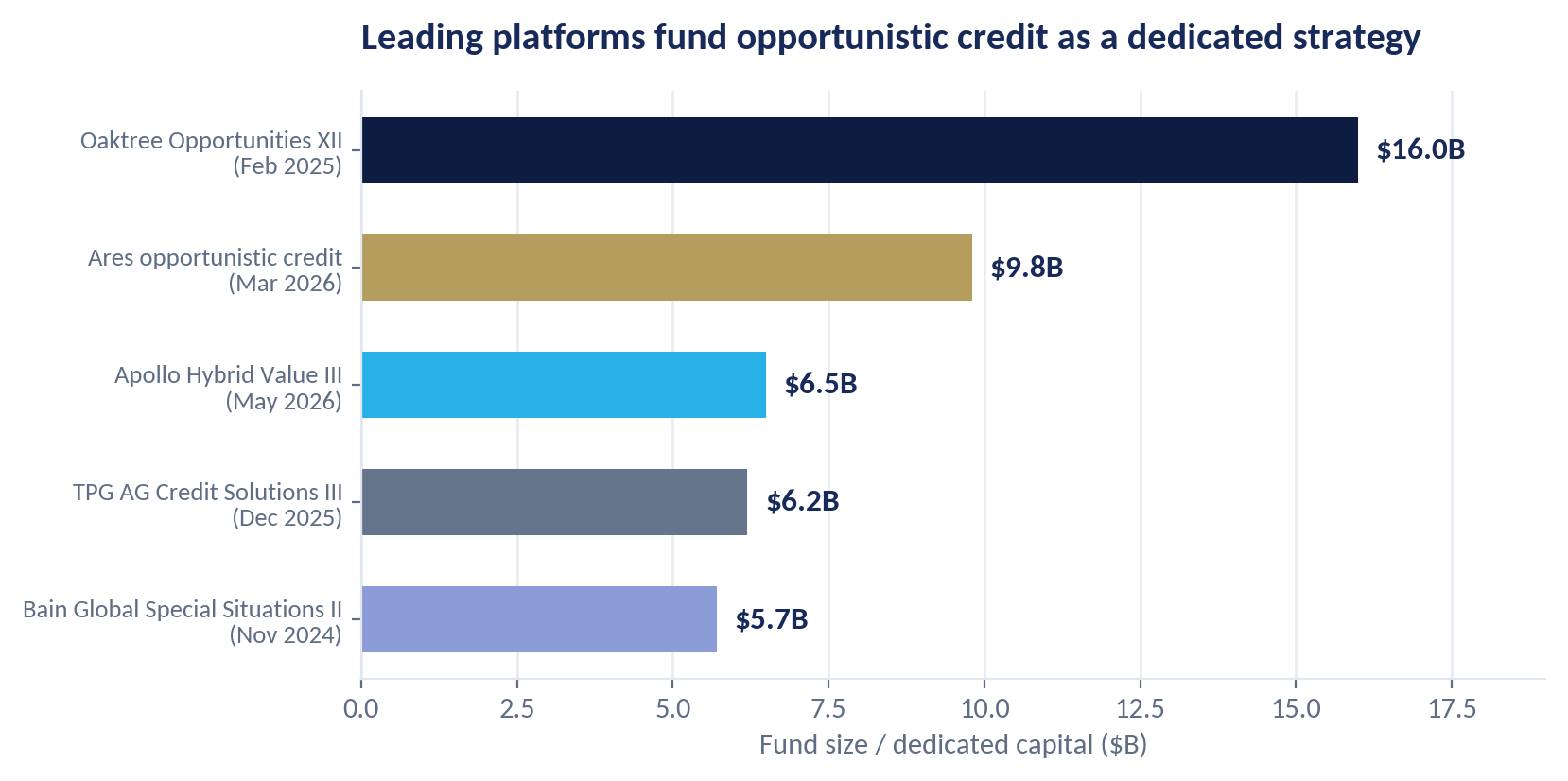
The largest platforms fund this as a dedicated strategy, and they have kept funding it through 2026. Oaktree closed Opportunities Fund XII at $16B in February 2025. Ares raised more than $9.8B for its opportunistic credit strategy, closing in March 2026. Apollo closed Hybrid Value Fund III at $6.5B in May 2026. TPG AG closed Credit Solutions Fund III at $6.2B in December 2025, and Bain closed its Global Special Situations Fund II at $5.7B in November 2024. These are dedicated pools with distinct mandates, talent and decision rights, organizationally separate from origination.25
For a firm that builds it, organizational design follows from the mandate, and four choices decide whether it works. Separation: the recovery team must sit apart from origination, with its own profit and loss, decision rights and a reporting line to the chief investment officer, so that the people who declare a credit impaired are not the people who underwrote it. Staffing: hire restructuring, documentation and liability-management talent now, because that expertise is scarce and becomes scarcer in a downturn. Triggers: codify watch-list governance and intervention triggers so escalation is automatic rather than discretionary, since informal processes intervene too late. Incentives: reward recovery and enterprise-value preservation, not the avoidance of near-term marks, because the wrong incentive produces the delayed restructuring.
The structural conditions for effective recovery already exist in direct lending. First-lien loans were 86.4% of BDC portfolios in the first quarter of 2026, and a lender holding the whole facility negotiates bilaterally rather than across a fractious syndicate. Medallia is what that advantage looks like when it is used. The advantage is realized only by firms with the people and processes to use it, which is the entire case for putting the capability on the book before the wall arrives rather than during it. Most middle-market lenders will not build all five functions, and they do not have to: the capability can be bought in stages, which is what Section 8 sets out. The build-or-buy decision is itself a credit decision, and either cost is small relative to the loss it prevents.
Taken together, these three moves convert the diagnosis into a system. The watch buys the lead time; the underwriting converts lead time into a decision; and the capability supplies the people, capital and governance to execute that decision before value runs off. None of the three works alone. An early-warning signal with no underwriting produces anxiety. An underwriting with no capability produces a plan no one can run. A restructuring with no operating capability produces Pluralsight. Together they are the difference between a managed outcome and a write-off, and across a concentrated book that difference compounds into the gap between a top-quartile and a bottom-quartile vintage.
6. The contrary view deserves a hearing
A paper that argues for urgency owes the reader the strongest version of the opposing case, and in 2026 that case is being made by serious people with good data.
- Non-accruals remain historically modest. J.P. Morgan Private Bank noted in March 2026 that publicly traded BDC non-accruals averaged about 2%, that non-traded BDC non-accruals ran at about 1.2% of cost against a ten-year average of 1.9%, and that defaults across high yield, leveraged loans and private credit were all at or below historical averages. Private credit is about 9% of total corporate borrowing, and roughly 80% of the investor base is long-duration institutional capital, which limits forced-seller dynamics.
- Software fundamentals are not collapsing. Fitch analysts argued in May 2026 that realized losses for first-lien lenders have been limited with most cases producing full or high-percentage recoveries, that software leverage, interest coverage and EBITDA trends have been somewhat positive, and that AI implementation still requires significant effort in any given environment. Fitch's own Q2 2026 data puts technology and software at the lowest default rate of any large sector.
- AI credit risk may be diffuse and manageable. KBRA's March 2026 deep dive analyzed 495 software and technology borrowers, flagged 165 of them, about a third, as relatively high AI risk, and identified 41 with debt maturing before the end of the second quarter of 2027. In a stress scenario in which all 41 default, KBRA's monitoring metric would rise only to 4.8% by count and 2.9% by value, with median exposure per rated vehicle below 2.5%.
- Agentic AI may expand the market rather than destroy it. Morgan Stanley Investment Management argued in April 2026 that while some AI disruption risks are valid in a narrow context, many are overstated for enterprise software, where durability, compliance, proprietary data and integration depth remain paramount, and that agentic AI can act as a market expander for incumbents.
- Defaults may simply fall. Moody's forecast in January 2026 that the US speculative-grade default rate would decline from about 4.5% at the end of 2025 to below 3% by the end of 2026, while noting that its own watchlist of potentially distressed issuers remained above average.
The reconciliation is threefold. First, these are aggregate statements about a book, and this paper is about the tail of that book. KBRA's own numbers concede that the high-AI-risk cohort already carries the weakest financials in the sample, so the disruption is in the numbers whether or not it is attributed to AI. Second, low reported defaults in software are consistent with, not contrary to, the thesis: software is 31% of the leveraged loan index's distressed loans, 21% of 2025 liability management exercises, and 1.2% of reported defaults, which is what deferral looks like on the way to resolution. Third, the recommendations in this paper are robust to being wrong about the macro. Continuous monitoring, a tailored playbook and a workout capability cost little in a benign scenario and are decisive in an adverse one. That asymmetry, not a forecast, is the argument.26
7. About the author
Jim Feldkamp is Managing Partner of Alary Capital. He has spent more than 25 years on the operating end of challenged companies, as a restructuring professional, chief executive, founder and investor, across more than $4 billion of transactions in North America and Asia. He underwrites recoveries the way he has spent his career executing them, from the operating seat.
- Restructuring principal. Asia head of BBK, the global restructuring firm later sold to KPMG, delivering turnaround, restructuring and interim-management mandates for private equity sponsors and corporates. This is the workout craft the stabilization and interim-leadership work is built on.
- Operational owner. Chief executive of a healthcare software portfolio company, which he led through restructuring to a completed exit: the full arc this paper argues the next cycle will demand. Earlier he led the turnaround of a joint venture with W. L. Gore through to its sale.
- Founder. Co-founder and chief executive of MingJian, an AI-powered platform serving Asian consumers, which gives him the founder's view of the software companies this work underwrites: the codebase, the renewal motion, and the people who hold both.
- Lender and investor. Before founding Alary Capital, a deal partner at Full In Partners, a New York growth-equity technology fund, where he underwrote software companies from the buyer's side of the table and built the firm's risk-management and continuous portfolio-monitoring systems.
He holds an MBA from INSEAD and dual bachelor's degrees in entrepreneurial management from the Wharton School and transportation engineering from Penn Engineering. An offshore sailor with more than a dozen ocean regattas behind him, and an active Rotarian.
8. How Alary works with lenders
Alary Capital works with lenders to get the best recovery from challenged asset-light credits, with operating capability, underwriting discipline and our own capital. We work two ways, as an investor that bids and as an operating partner paid on the recovery it produces. One underwriting runs both, and you choose which seat we take on a company, in writing, before the work starts: a bid from us where the company fits our criteria, or an operating partner with no bid. On any one company we hold one seat, never both.
You set the recovery objective, and every engagement reports against it. The way in is staged, and each stage earns the next: the portfolio watch across the book, with no name designated and nothing signaled; the first read on one name; then exit underwriting where the first read has earned it, ending in a conclusion of go, no-go, or sell as-is. Each stage is priced to stand on its own, and none of them asks you to commit ahead of the evidence.
We are not a banker. We do not run sale processes, contact buyers, negotiate transaction terms or handle proceeds. When it is time to sell, the mandate goes to a banker, walking into a process the underwriting has already made ready.
The next phase of the cycle will be decided over the next 18 months. As the 2028 wall approaches and the AI repricing of software works through portfolios, stressed credits will cluster, and the lenders that can see them early, underwrite the recovery precisely, and execute across the full range of roles will protect principal while others write it down. Medallia showed what the capability is worth when it is present. Pluralsight is showing what its absence costs, twice. That capability does not appear on demand. It is built, or bought, ahead of the storm.
The ask is the smallest one. Start with the portfolio watch, or a first read on one name. No name is designated, no borrower is contacted, and nothing is signaled. Judge us on the report.
The loan was underwritten. So is the recovery.
Jim Feldkamp · Managing Partner, Alary Capital · info@alarycapital.com · linkedin.com/in/jamesfeldkamp
Nothing in this document is an offer to sell or a solicitation of an offer to buy any security, or investment, legal, tax or accounting advice, nor a recommendation regarding any specific security or transaction. Fee amounts, engagement terms and any outcome-linked compensation are set out in the proposal and the engagement documents. Alary Capital does not run sale processes, contact buyers, negotiate transaction terms or handle proceeds. Figures are drawn from third-party sources believed reliable as of August 2026 and are cited in the footnotes; market conditions and data are subject to revision. Named companies are discussed solely on the basis of public reporting.
Sources and notes
- Sources: Moody's Ratings, Feb 2026 and Apr 2026; Financial Stability Board, Report on Vulnerabilities in Private Credit, May 6, 2026; IMF Global Financial Stability Report, April 2026; Fitch Ratings via Bloomberg, July 30, 2026.
- Sources: Federal Reserve, FOMC statements, September, October and December 2025 and July 29, 2026; Summary of Economic Projections, June 17, 2026. SOFR was 3.65% on August 24, 2026.
- Sources: Proskauer Private Credit Default Index, Q2 2026 (716 loans, $195.6B original principal); KBRA DLD trailing-twelve-month issuer default rate, June 2026; Fitch Ratings via Bloomberg, July 30, 2026; PitchBook LCD BDC non-accrual analysis, Q1 and Q2 2026.
- Sources: PitchBook LCD dual-track default rate series, 2019 to May 2026; Moody's Ratings, "Lend, extend, and then...", May 18, 2026, covering 1,173 borrowers from 1979 to 2026.
- Sources: BIS Quarterly Review, March 16, 2026; J.P. Morgan Asset Management, February 10, 2026; Moody's Ratings, April 7, 2026; PitchBook LCD, February 4, 2026; Fitch Ratings, Q2 2026.
- Source: Bank for International Settlements, Quarterly Review, "Private credit's software lending meets AI disruption," March 16, 2026.
- Sources: Bessemer Venture Partners cloud index via Meritech, June 22, 2026; BIS Quarterly Review, March 2026; Aventis Advisors, Rule of 40 in SaaS, May 2026 (updated August 11, 2026); SaaS Capital 15th annual growth benchmarks, August 19, 2026.
- Source: ICONIQ Growth, State of AI report, January 2026.
- Sources: J.P. Morgan Asset Management, "Tech, Software, and BDCs," February 10, 2026; Moody's Ratings, April 7, 2026.
- Source: PitchBook LCD, US Private Credit Monitor, April 14, 2026.
- Sources: PitchBook LCD leveraged loan amendment analysis, data through July 2025; Houlihan Lokey via Octus 2026 Distressed Outlook; Apollo Academy, Software Maturity Wall, February 2026; Moody's Ratings via PitchBook, 2026.
- Source: Federal Reserve, Senior Loan Officer Opinion Survey, July 2026.
- Sources: Proskauer Private Credit Default Index, Q2 2026; KBRA via Bloomberg, June 16, 2026; Fitch Ratings via Bloomberg and Investment Executive, July 30, 2026.
- Sources: PitchBook LCD, February 4, 2026; Octus; Fitch Ratings, Q2 2026.
- Sources: Federal Reserve Bank of Boston, "Early Warning Signals in Private Credit? What BDC Portfolios Reveal," 2026; CAIA, April 20, 2026; PitchBook LCD, Q1 2026.
- Sources: Moody's Ratings, April 7, 2026; CAIA, April 20, 2026.
- Source: Proskauer private credit deal data, reported via PitchBook, 2026.
- Sources: Moody's Ratings special comment, August 16, 2018; Fitch Ratings, "Liability Management Transactions Drive Down U.S. Recoveries," December 20, 2024; John Zito of Apollo, March 2026, as reported by CNBC and The Wall Street Journal.
- Sources: PitchBook LCD using S&P Global LossStats, May 31, 2024; Moody's Ratings, "Lend, extend, and then...", May 18, 2026.
- Source: Cambridge Associates, "A New Era of Dispersion in Direct Lending Favors Disciplined Managers," April 2026.
- Sources: Goodwin Procter and Davis Polk transaction summaries, August 2024; Private Equity Wire, August 23, 2024; CreditSights and ION Analytics / Debtwire commentary, 2024.
- Sources: Octus case study on the Medallia restructuring, 2026; Medallia press releases, June 17 and August 3, 2026; Businesswire, June 17, 2026; reported coverage, April to August 2026.
- Sources: BDC Credit Reporter, Q4 2025 and Q1 2026 updates on Pluralsight; Moody's Ratings, May 18, 2026. Individual fund-level marks are deliberately not reproduced here.
- Sources: SaaStr analysis of at-risk private-equity-owned SaaS credits, April 2026; PitchBook LCD and Octus distressed technology data, February 2026. The $50B figure covers total debt across the named cohort and is not the same measure as the $46.9B of technology debt trading at distressed levels.
- Sources: company announcements. Oaktree, February 10, 2025; Ares, March 30, 2026; Apollo, May 5, 2026; TPG, December 9, 2025; Bain Capital, November 18, 2024. Note that TPG's former special-situations platform, TSSP, separated in 2020 and is now the independent firm Sixth Street.
- Sources: J.P. Morgan Private Bank, March 12, 2026; Fitch Ratings via Global Finance, May 15, 2026; KBRA, "Private Credit: Deep Dive on AI and Software," March 27, 2026; Morgan Stanley Investment Management, April 1, 2026; Moody's Ratings outlook, January 2026.